
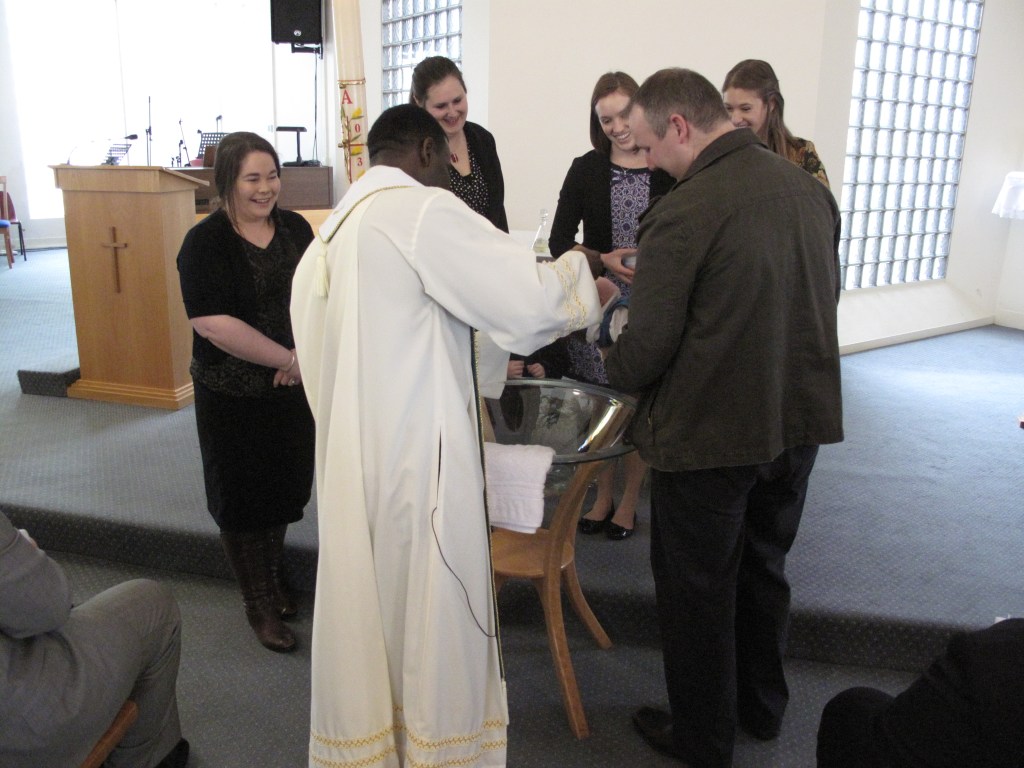
This is a question I’m asking myself now I’m of an age with way more time behind me than ahead. I’m also a Catholic and have been so since I was thirty two days old. Following religious tradition, my parents took me to their local church where prayers were said and promises made, a priest poured water over my unsuspecting head of black hair, and for better or worse, I was now a Catholic. I have a certificate to prove it. Not that I actually had a choice.
Most religions are passed down through family. My father was born into a Catholic family and my mother became a Catholic not long before she married, so it was taken for granted that my three brothers and I would be Catholics too.
If I had been born in a Middle Eastern family I would probably have been a practicing Moslem, wearing a headscarf and praying to Allah. Or, with a name like Judith, I would have been right at home in a Jewish family, keeping all the religious rules about food and dress, but leaving the more important religious stuff to the males. More realistically, I might have grown up in a Methodist family like my mother did, going to Sunday school with my cousins, familiar with long hymns and able to quote bits of the Bible, chapter and verse
As it was, I learnt to colour my life the Catholic way. There were rules laid down to deal with any religious issues that might arise and a recognised line of authority to respect. Theology was the province of the clergy and contemplative prayer belonged in monasteries and convents. These were my boundaries and it wasn’t until I was in my thirties that I began to question them.
Talk about religion is as divisive as talk about politics. Is religion something one grows out of, like a school uniform or a wedding dress that still looks wonderful but no longer fits?. Then there’s the matter of the sexual abuse of children that for decades hid behind religious walls.
We don’t need historians or social scientists to tell us that the rate of change over the last fifty years is the highest it has ever been. Religion has been caught up in those changes. Church pews are more empty than full, churches are no longer open all hours, but locked to keep insurance costs down. Many country churches have been creatively re-purposed into family homes and bed-and-breakfasts.
Weekends have had a makeover. Shopping malls are a go-to gathering space, football moved across to Sunday and children’s sport has done the same. Weddings and funerals, once family affairs marked in a familiar church, are more often celebrated in a garden or a specialised religion-free space and christenings or baptisms replaced by a naming ceremony or first birthday celebration
All religions have a basic common goal expressed in a multitude of ways, namely to seek God. On a world scale, religious doctrines, moral codes and rituals each reflect something that is true and holy. The origins of hospitals, schools and social services can be traced back to a spiritualty that began as something deeply personal that eventually spread and expressed itself religiously. Religion puts shape around our values – that the sick will be cared for, the hungry fed, the homeless sheltered and justice is a right for all.
Not long ago I stood in the little side chapel where I had been baptised and wondered at the way Catholicism has marked my life. There have been times when I have been tempted to experiment with another brand of Christianity, one with better music or a more open approach to divorced people, a church that welcomes a woman as priest or pastor or minister, a church where a women’s viewpoint is respected and their skills appreciated. Along the way I’ve learned – and had to unlearn as well – a great deal about religion, catholicity in particular. I’ve discovered that all religions have a common goal: to reveal God’s presence in all of us.
Somehow, I always return to the basic fact that my way to God is to be found in the Catholic tradition, even while I’ve given myself permission to colour outside the lines.
Judith judith@judithscully.com.au
 Words From The Edge