A mother and her daughter

This is number 3 in a series of reflections about Gospel women, many of them un-named, and an appreciation of feminine imagery and experiences that are prominent in many of the stories Jesus told. 

Jesus grew up in a culture where the adult Jewish male thanked God each day in prayer “that thou hast not made me a gentile, nor a woman, nor an ignorant man”. Then he met a woman who ticked two of the three no-goes. Not only was she a woman, hardly worthy of being known by name, but she was Greek by birth, a Canaanite by religion, living in a seaside town in a part of the world we know as Lebanon.

It begins as a mother and daughter story. The daughter suffered from some kind of disability, the kind that at the time was described as being ‘tormented by a devil’. The mother, like mothers the world over, then and now, was frantic that her daughter was be able to live a normal, healthy life the same as other girls her age.  In a careful reading of Matthew 15: 21-28, this mum comes across as a risk-taker, strong enough to cope with rejection and hostility, a smart talker, witty, and very determined.

In the way news travels through a small town, she’d heard rumours about a visiting Jewish preacher, someone who had healing powers. She tailed him through the town, making a nuisance of herself and annoying his already disgruntled little band of followers who were looking for a bit of R and R.  Jesus ignored her.

Even though the woman was careful to address Jesus as “Lord”, and even knelt before him to make her plea for mercy, Jesus gave her the silent treatment.

As an Israelite male Jesus was not obliged to even recognise this pagan woman. The disciples, used to his usual counter-cultural approach to other women, Jewish women, and  fed-up with this persistently annoying woman, suggested he give her what she wanted anyway.  

Instead he insults her, referring to her as a dog, and offense in every language, even today. And she retaliates. “Ah yes, Lord. But even little dogs eat the scraps that fall from their master’s table. “

Something happened then, something deep in Jesus moved, changed. “Woman, you have great faith. Let your desire be granted.” It was a turning point in Jesus’ life, a growth marker. In an instant his ministry moved beyond Judaism and encompassed the whole world.  He would never forget that it was a pagan woman’s faith that called him to move into a place where he saw his life and the will of his Father from a totally different aspect.

That gutsy Canaanite woman who had humiliated herself for love of her daughter, would never have known that her words and her faith would echo down through the ages her story giving counyless women inspiration and strength to follow their God-given instincts.  Now, more than ever, women like her are questioning and even breaking religious and cultural taboos that prefer them to walk in the shadow of an authoritarian male leadership.

Through every avenue available in a supremely audio-visual world, women need to talk persistently, calmly, and sometimes passionately, about the things in Christianity that challenge and disturb them. Hopefully their faith will shatter a few more taboos.

Judith   ( judith@judithscullu.com.au)
Disabled

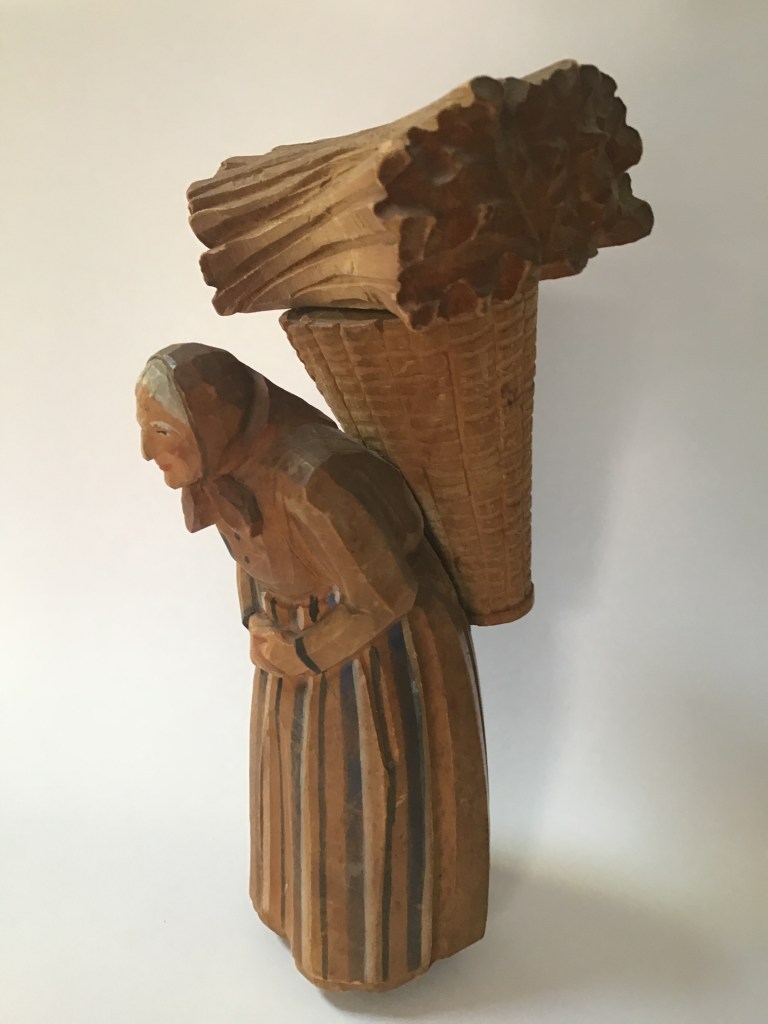
A few years ago I bought this small wooden figurine of an elderly woman, kerchiefed and bent, weighed down by a load of firewood. She stands on the window ledge behind my laptop and sometimes I look at her and say, “Me too,” because how she looks is how I feel. It’s not a load of firewood that is bending my back, but the seeming endlessness of this Covid pandemic, or the everyday burdens that come with ageing. More often than I like it’s the backpack of theologically outdated and outgrown beliefs and practices that I still carry around because can’t quite bring myself  to put down and trust what I see when I look up and out.

One Saturday morning a couple of thousand years ago, a bent-over woman shuffled into her local synagogue and sat down in the space set aside for women. Familiar but virtually invisible, she was alienated by a community perception that her condition was just punishment for some hidden sin. Jesus, a visiting preacher there by invitation of the synagogue leaders, noticed her sitting apart on the stone bench that ran the length of the little synagogue.

If you have ever felt how she might have then Jesus’ next move might be confronting, because he invited the woman   to move out of her space and into the ring of watching and listening men. The choreography speaks to me, and I wonder why Jesus didn’t move over to where she was.

 Instead, in spite of her fear, she did as he asked and moved from the edge where custom had placed her and right into the centre where Jesus stood. In one fluid movement he bent down, looked into the woman’s eyes and reached to embrace her. Her head lifted, her back straightened and she found herself looking into Jesus’ eyes.

Jesus and the woman stood united. In the eyes of the surprised and scandalised synagogue president this visiting preacher was aligning the woman with themselves.

Not for the first time Jesus had moved out of recognised religious boundaries and was standing with the disenfranchised and the marginalized. The centre had moved and religious authorities suddenly found themselves standing on the periphery. Outraged, they spat out words that put the blame onto the one who minutes before had been burdened not just by her physical condition but by cultural traditions and expectations.

Until Jesus reached out to her, humiliated for reasons beyond her control, her dignity ignored, nobody else had stopped to see the woman she was inside. It takes courage to hang on to your best self when circumstances beyond your control push you out to the fringe. It takes courage, too, to move into a place at the centre, a place that seems reserved for others.  Maybe her making that move in response to Jesus’ loving invitation was the miracle that enabled the healing.

It seems to me that Gospel stories about Jesus and woman have a great deal to tell us in this time when we are losing touch with religion as we have known it. The interaction between Jesus and this unknown, crippled woman, is a story for our time. You’ll find it in its more familiar wording in Luke’s Gospel, chapter 13, verses 10-17. All of us are in it somewhere, sitting or standing.  Let it talk to you.   

Judith (judith@judithscully.com.au)

Share this post with a friend or on your social media accounts. .