Catholic on the edge

In the wake of Covid a lot of attention is being paid to issues like women’s rights, family violence, aboriginal rights, political failures in basic morality and so on, all worthy of time, money, attention. Running parallel with all this is planning for the Fifth Plenary Council of Australia, due to begin this Sunday. Covid hasn’t stopped top level sport and it’s not going to stop this long-planned Catholic talk-fest either. Whether now is the time for football, or discerning the future of the Catholic Church in Australia, is problematic.

The last Plenary Council was held in the year of my birth and Baptism. Just as my baby pictures no longer bear any resemblance to what I see in the mirror today, neither does today’s Catholicity. A few months ago I wrote Catholic in the religion section of the census form but I’m not sure that where I sit, out on the edge and a long way from the Catholic centre, actually makes me a ‘good’ Catholic.

Out on the edge of things, far away from the years of preparation that Catholic women and men have been putting into this Plenary Council, I’ve been doing a lot of thinking about God and my Catholic beliefs. What I am going to write next is probably heretical, but here goes – is God a catholic?

I’m not even going to try to open up that can of religious worms right now – if ever, but I hope to talk more about it in the coming weeks. Over lockdown I’ve ever so slowly been putting into words what I understand, and sometimes just sense, about God and Jesus and the practices and beliefs that have been gathered into Christianity. I’m still only half-way through what I plan to write, and already onto the third draft as I struggle with the depths of meaning in church words that I thought I understood.  

I’ve s-l-o-w read books and articles by reputable theologians that  have challenged my understanding of life-long, taken-for-granted religious beliefs. I’ve come to the conclusion that my post-Vatican 2 theology is possibly a little worn and dated, so this week Australia Post has dropped a parcel of books at the front door. They are all-Australian, authors and publisher (Coventry Press) alike.

New Wineskins : Eucharist in Today’s Context by Frank O’Loughlin

Broken for You : Jesus Christ, the Catholic Priesthood and the Word of God by Francis J. Moloney

Call No One Father ; Countering Clericalism in the Catholic Tradition by Berise Heasly

Dawn to Dusk : Towards a Spirituality of Ageing by Noel Mansfield MSC

No Greater Love : The Human Experience of God by Brian Gallagher MSC

They are not long books and I will read them with a highlighter in hand and an attitude that might be called ‘deep reading’, listening for the voice of God in the world we live in. Which I believe is also the task facing the members of the fifth Australian Plenary Council.

Judith        judith@judithscully.com.au
A Kind of Dreaming

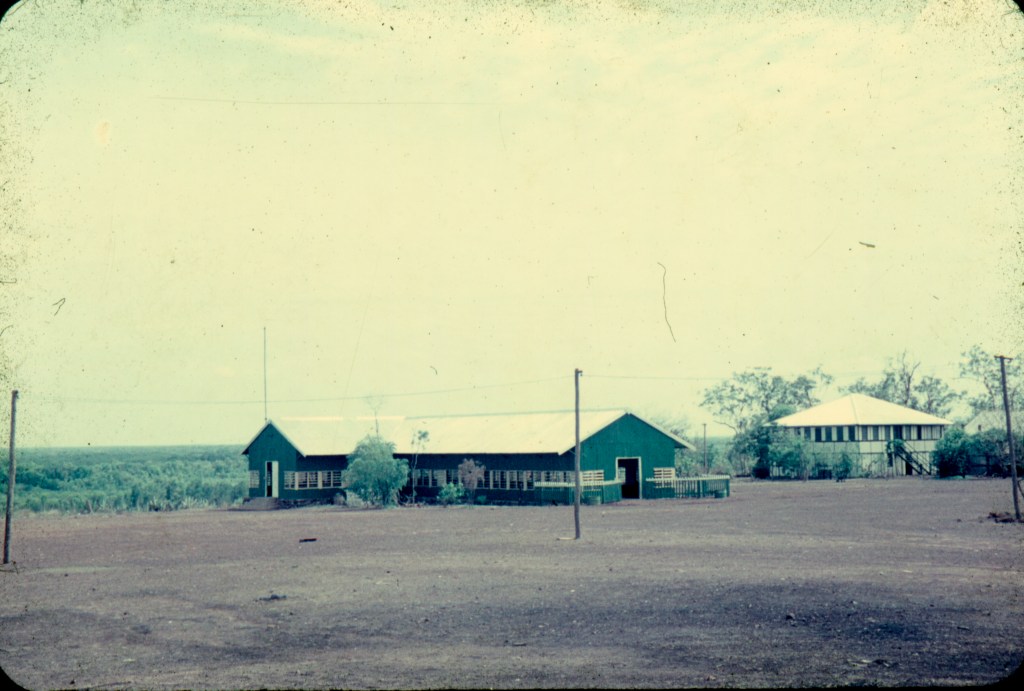
 A very long time ago, back when I was a young nun, unwrinkled and still believed I would live forever, that things would only get better and better, I spent 12 years in the Northern Territory. The ink was barely dry on my teacher’s registration when I had been assigned to a place called Port Keats, now known as Wadye.

Wadye church and school some time in the 1960s

 My idealism wilted momentarily when I stepped out of the plane on the Darwin runway and the heat rose up like a wall. It definitely sagged when the sandflies from appropriately named Sandfly Creek sent out messages that there was fresh southern blood up at the Mission. But I survived, and would eventually move on to football-famous Bathurst Island, back to Port Keats and later on to Daly River.

Life for Aboriginals on reserves and mission stations was very different in the 1960’s. The government was paternalistic, local language was not respected, the original owners of the land  had no voting rights and the catchword was “assimilation”. Policies which today we regard as outdated, barbarous, cruel and racist were the norm.

Previously strong family units struggled to survive when school-aged children were accommodated in dormitories and denied daily access to their parents. People were housed in sub-standard huts without toilets or running water.  Aboriginal children grew up with low self-esteem and little pride in their culture.

 As a missionary nun and a teacher I was living in a ‘them and us’ world. We missionaries unwittingly gave out non-verbal messages that Aboriginal culture was primitive, of no value, to be replaced by religion. It was only towards the end of my years in the N.T. that I started to get a sense of the hidden dignity and richness of the Aboriginal culture. Even then I didn’t have any great appreciation of what the land meant to each and every Aboriginal person. 

Australian people are slowly trying to put right the injustices our First Nation people have suffered since the first Europeans dropped anchor in Sydney Harbor. We are just beginning to appreciate their dreaming spirituality and their languages. I thank them for the privilege of living in this great space we call Australia. I am grateful for the skill with which Aboriginal people looked after this land for thousands of years, for the love that underwrites their stories and dance.

Reading as well as listening to Aboriginal people when they speak about their relationship with the land, has freed something unspoken in me, about who I am and where I have come from. When I contemplate the Mallee country that I see as ‘my country’ I have a sense of oneness with that land. It helps me understand how Aboriginal people might feel about their country, even though I know that non-Aboriginal people not assume that Dreaming spirituality can mean the same thing to all people. The last thing Aborigines need is another appropriation by members of the dominant culture of something that is distinctively theirs.

Eugene Stockton, a retired Catholic priest and archaeologist, understands it like this; “If I was born in this land, by Aboriginal belief I have pre-existed here like them from the timeless Dreaming. So, on their reckoning, I have with them a common bond and common spiritual roots in this continent, although racial roots through my parents, lie elsewhere.”  (Eugene Stockton : Coming home to our land – 1988)

Whether one comes from the Ireland, the Philippines, Sudan, Vietnam, Afghanistan or wherever, I feel sure that the pull to the land and the landscape of one’s ancestors is embedded deeply within.

And as Ezekiel says, “I will take you from the nations and gather you from all the countries and bring you to your own land……. And you shall dwell in the land I gave to your forefathers. You shall be my people, and I will be your God.” (Ezekiel 36: 2, 28)

Judith ( judith@judithscully.com.au)