
What is it about babies? They’re tough but oh so vulnerable. They carry within them a future that is chock full of possibilities. They snuggle up in one’s arms in a wordless recognition of security. Their neediness could break your heart and exasperate you to the edges of reason and back. They bring out a tenderness hidden in the most unexpected people. They link the past with the future.
And this is how God chose to be revealed to us – as a baby.

For the first couple of months, like all parents, Mary and Joseph would have talked to their baby, smiled at him, waiting for his response. Parents will remember this time. When the first smile comes, you know that you have wakened love in the heart of your child. You reach out to one another in delighted recognition, in mutual love and relationship. This is how God feels about us.
The powerlessness of the baby is powerful indeed.
Yet no one likes to feel powerless – out-of-control bushfires, drought that depletes the land, world leaders riding high on their own power, refugees kept in indefinite detention, bullying at any level, traffic snarls, the infirmities of age.
Right through Old Testament centuries and on through most of the last two thousand years, religious authorities have invested God with power and might, forgetting that the Christ who was born into our world at Christmas is also the God of helplessness and vulnerability. We need to trust our powerlessness because it has the power to make us more courageous, more compassionate. 
So whatever part of you is niggled by a feeling of powerless this Christmas – and there’s bound to be something – steal a look at the Baby in his mother’s arms.
The power of Christmas is in a baby’s power to transform a heart, divine power hidden in human weakness.
This is the paradox of Christmas.
May the blessings of Christmas peace be with you and yours.
Judith Lynch (judith@judithscully.com.au)
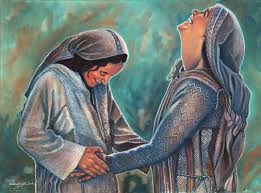 Elizabeth and her kinswoman Mary were two women in crisis, one young, unmarried and pregnant, the other much older and expecting a never-to be-expected first child. Mary did not go to Joseph for understanding, or to her father for protection. Neither did she go to the temple priests for vindication. Confused and needing support, she did what women across the ages have done – she sought the company of another woman, one she could trust, a woman who herself was also in an extraordinary situation.
 Words From The Edge