
It was summer when we moved to Warrandyte, where the houses are tucked into leafy green folds, lean gum trees climb up and down the hills, and the possibility of bushfire lurks behind every hot day.
During the will we / won’t we buy stage we had decided that the dirt road was charming, the sloping driveway manageable and the absence of a shed for all those absolutely necessary boy’s toys, could be easily remedied. The windows, whole walls of them, were amazing, bringing new meaning to our previous experience of light and airy.
A first winter in any location is a time for the new residents and a house to really get to know one another. That summer, followed by a balmy autumn, was our honeymoon period, so the real knowing came with the first cold snap, closely followed by a power bill that owed most of its total to ducted heating. Now we saw the sense of those heavy roman blinds on all that lovely exposed glass. Reluctantly we shut out the night and kept the heat in.
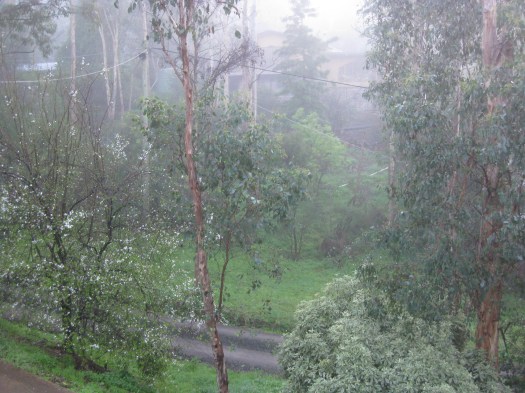
Now eight years later and it’s winter again. The mornings are cold, mist drifts through the green of the eucalypts and evenings close in before 6 o’clock.
It’s then we light the fire. It doesn’t do much to increase the inside temperature but it looks wonderful. Something about it slows me down, centres me. Back in the summer the smell of smoke in the air could set me panicking. That’s the thing about fire – it can comfort and it can consume.
The house is flat roofed and the cathedral ceilings are timber lined, so we hear even the gentlest of rain. Most nights thick layers of cloud block out the starlight, with not even a streetlight to send fingers into the deep shadow.
People talk about a dark night of the soul and it can mean many different things. John of the Cross, a Carmelite who lived in the 1600s, said that an experience he saw as a dark night is caused by the presence of God that is so bright that it results in darkness. When I read things like this I think of winter nights in our unlit valley and feel that I am out of my depth. But doesn’t any God talk take us out of our depth?
It is said that the landscape is the face of God, turned to us and inviting us in. Our Australian landscape invites us to recognise God in the seasonal manifestations of the Creator’s complexity. The prophet Isaiah was aware of this when he said, “God will be a shelter and shade from the heat of the day, and a refuge and hiding place from the storm and rain.” More God-talk!
The one vehicle dirt road is not so charming these days – gently pot-holed and slippery in winter, dusty the rest of the year. The driveway seems a little steeper than it was eight years ago, or maybe that’s my knees talking, and the boy’s toys are in the shed.
And sometimes in the morning mist I catch a glimpse of who God is. I see, but I don’t see. Things like the biting chill of winter, the gentle patter or occasional clatter of rain on the roof, the wood smoke scented evening air, remind me of a Presence as ephemeral as it is real. And just when I begin to think that I might understand the mystery of the who or what of God, it’s gone.
Judith Scully (judith@judithscully.com.au)
 Words From The Edge